马上注册,阅读更多内容,享用更多功能!
您需要 登录 才可以下载或查看,没有账号?立即注册 
×
Post-Treatment Imaging in Lung Cancer Patients: Adherence to Surveillance Guidelines Associated with Improved Survival in a Longitudinal Cohort
主动检查与症状指导的影像检查相比显著提高生存。
AS was associated with significant survival benefit compared to symptom-driven imaging which is not fully explained by lead time bias. This contrasts with prior reports failing to demonstrate benefits of more intense surveillance.
Objective: Understanding the impact of surveillance for NSCLC survivors is critical given the significant risk of recurrence and secondary primary tumors. Retrospective studies have been limited in their ability to discern surveillance from symptom-driven imaging to determine effect on clinical outcomes. We evaluated the association between active surveillance and survival.
Methods: The cohort was defined as Stage I-III NSCLC patients who received curative-intent therapy and survived >6 months (mo) within the Veterans Health Administration (2008-2016). Based on contemporaneous NCCN guidelines, the primary exposure was active surveillance (AS) time defined as time up to 9 mo following CT or PET chest imaging with indication of surveillance as determined by abstraction of radiology and clinical notes. Time-to-event analysis was applied, using time-varying exposures for AS as a continuous variable and categorized (0%, 1-24%, 25-49%, 50-74%, >75%). Regression models were adjusted for clinical characteristics. Subgroup analysis was performed among patients with recurrence.
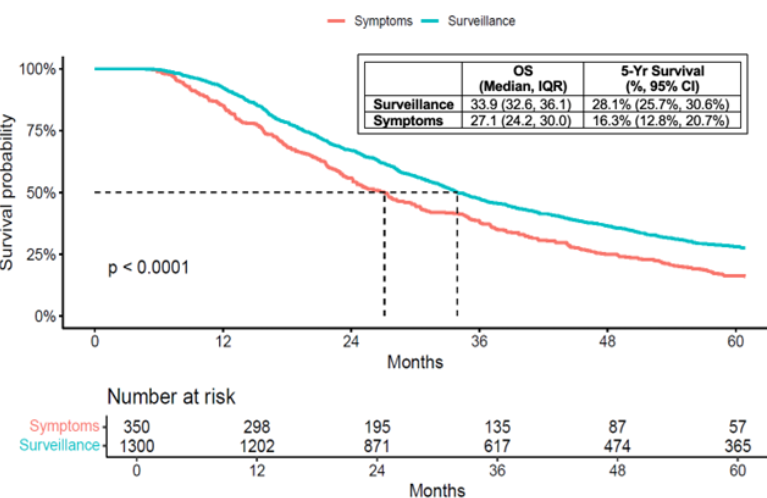
Results: The cohort consisted of 5650 Veterans; White (73%, 4127), male (97%, 5457) with Stage I (54%, 3043) Adenocarcinoma (46%, 2582) treated with Surgery alone (52%, 2943). Overall imaging for surveillance made up 69% (n=5937/8587) of all post-treatment imaging, 8% (642) for symptoms, 11% (867) for follow-up of prior imaging, and 14% (1141) for unknown reasons. Proportion of patients in AS was 42-57% for 1-5 years follow-up. AS was associated with a reduced risk of death HR 0.92 per 6 mo [95%CI 0.89-0.95, p<0.001]. Compared to no AS, AS time was associated with reduced risk of death (1-24%, HR 0.87 [0.74-1.02]; 25-49%, HR 0.79 [0.69-0.90], 50%-74%, HR 0.68 [0.60-0.76], >75%, HR 0.67 [0.60-0.75]). Imaging performed for symptoms was not associated with reduced risk of death (HR 1.05 per 6 mo [1.00 –1.11, p=0.055]). For subgroup analysis of 2199 patients with image-detected recurrence, median survival was 34 mo [33, 36] for surveillance-detected recurrence vs 27 mo [24, 30] for symptoms, p<0.0001 (Figure 1). After recurrence, median survival was 14 mo [12, 15] for surveillance vs 7 mo [6, 9] for symptom-detected recurrence.
Discussion: AS was associated with significant survival benefit compared to symptom-driven imaging which is not fully explained by lead time bias. This contrasts with prior reports failing to demonstrate benefits of more intense surveillance.
Nicole Lin (1), Amanda Immidisetti (1), Scott Adams (2), Ntemena Kapula (1), Julie Wu (1), Steven Zeliadt (2), Steven Asch (1), Alex Sox-Harris (1), Ann Leung (1), Summer Han (1), Leah Backhus (1), (1) Stanford University, Stanford, CA, (2) VA Palo Alto, Palo Alto, CA
|

