马上注册,阅读更多内容,享用更多功能!
您需要 登录 才可以下载或查看,没有账号?立即注册 
×
Postoperative MRD status Refines Recurrence Risk Stratification Beyond Pathologic Response After Neoadjuvant Chemoradiotherapy for Esophageal Cancer
新辅助化免治疗后术后MRD状态优化病理缓解预测复发风险分层
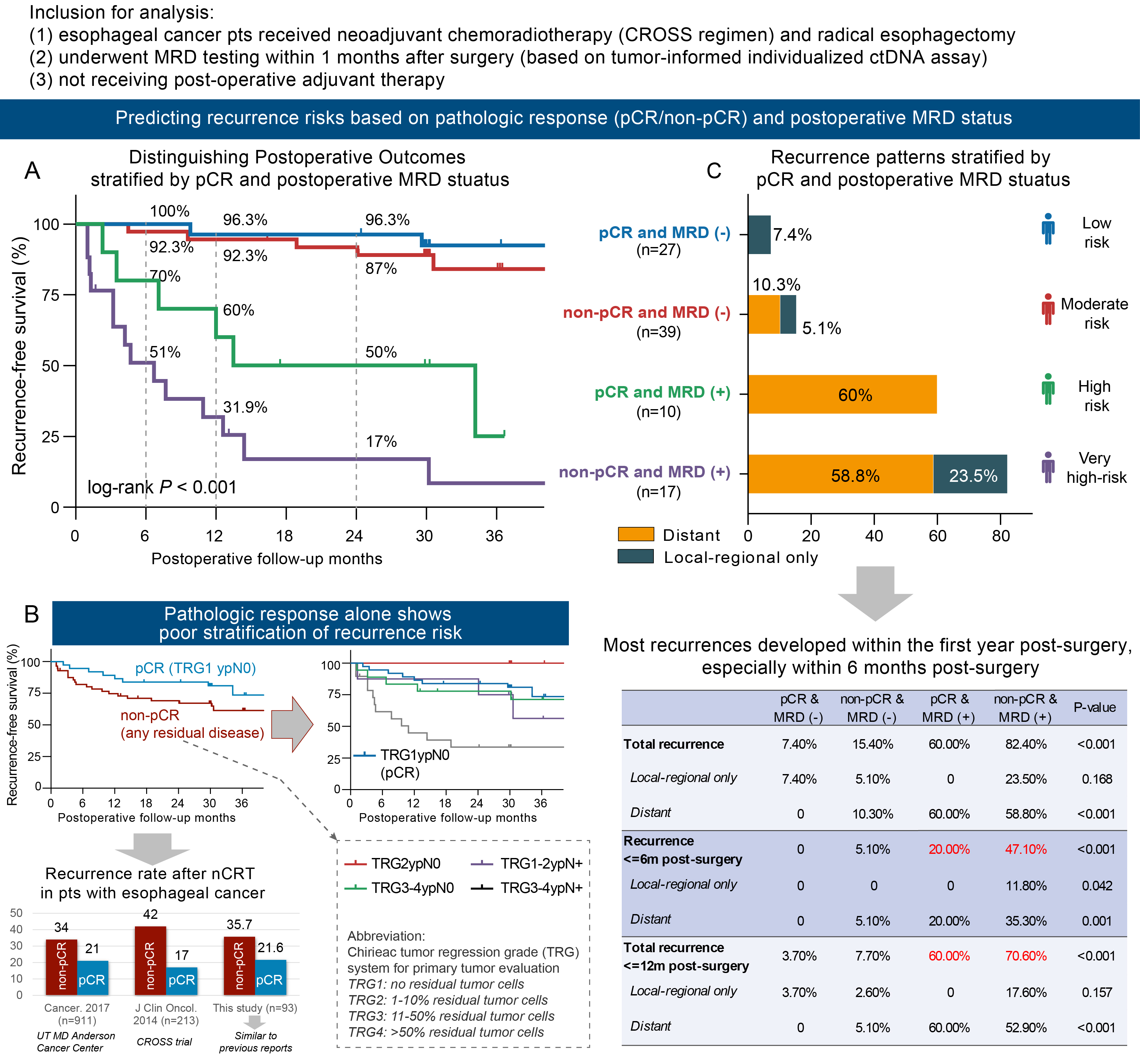
Objective: Accurate recurrence-risk stratification is critical to guide adjuvant therapy decisions in esophageal cancer after neoadjuvant chemoradiotherapy (nCRT) and surgery. Pathologic complete response (pCR) and non-pCR have traditionally been used for risk assessment but show limited discrimination. Minimal/molecular residual disease (MRD) testing via circulating tumor DNA (ctDNA) analysis offers a promising approach for recurrence risk prediction. This study evaluates the combined utility of pathologic response and postoperative MRD status in predicting recurrence patterns.
Methods: From a prospective clinical trial conducted between 2019 and 2023, patients with locally advanced esophageal cancer who underwent nCRT (CROSS regimen) followed by radical esophagectomy without adjuvant therapy were included. Peripheral blood samples for ctDNA testing were collected within one month after surgery. MRD status was assessed by a tumor-informed personalized ctDNA assay (50 patient-specific somatic mutations). Recurrence-free survival (RFS) and recurrence patterns were analyzed based on pathologic response and MRD status.
Results: Of 93 eligible patients (follow-up 30 months), MRD status significantly stratified RFS within both pCR and non-pCR subgroups (Figure A), while pathologic response showed poor stratification for RFS (Figure B). Among non-pCR patients, the 2-year RFS rate was 17% for MRD-positive vs. 87% for MRD-negative. Among pCR patients, the 2-year RFS rate was 50% for MRD-positive vs. 96.3% for MRD-negative. A combined classification approach (based on pCR and MRD status) identified four distinct recurrence risk subgroups (low, moderate, high, and very high risk; Figure C). Most recurrences occurred within the first year post-surgery, particularly within 6 months post-surgery (early-recurrence). The 1-year recurrence rates were 3.7% for pCR&MRD-negative, 7.7% for non-pCR&MRD-negative, 60% for pCR&MRD-positive, and 70.6% for non-pCR&MRD-positive groups.
Conclusions: Postoperative MRD provides improved predictive value over pathologic response in identifying patients at risk of early and distant recurrences. Integrating MRD with pathologic response enables a refined prognostic risk stratification framework that may guide personalized adjuvant therapy strategy (e.g., systematic and/or local therapy). Further validation in prospective interventional trials and in different neoadjuvant therapy are warranted to confirm its clinical utility.
Zhichao Liu (1), Boyao Yu (1), Yuxin Yang (1), Yang Yang (1), Chunji Chen (1), Xinyu Yang (1), Shaoyuan Zhang (1), Chunguang Li (1), Zhigang Li (1), (1) Shanghai Chest Hospital Affiliated to Shanghai Jiaotong University, SHANGHAI, China
|

