马上注册,阅读更多内容,享用更多功能!
您需要 登录 才可以下载或查看,没有账号?立即注册 
×
Integration of Clinical Risk Factors Improves Lung Cancer Risk Stratification by Radiomic Machine Learning
影像组学整合临床风险因素改善肺癌风险分层
Objective: Sybil is a validated radiomic deep learning program developed to generate predictive risk scores for lung cancer (LC) from screening low-dose CT (LDCT) scans alone. We sought to investigate whether integration of clinical risk factors would improve LC prediction.
Methods: Retrospective review was conducted for all patients who underwent screening LDCT in our health system from 1/1/2021 – 12/31/2022. Sybil software was used to generate annual LC risk scores from the LDCT images for the succeeding six years after the time of imaging. Clinical factors collected included demographics, smoking history, emphysema/COPD, prior screening history, personal history of cancer, family history of LC, and initial Lung-RADS score. Radiomic risk scores and clinical information were then compared between patients subsequently diagnosed with LC and those with no LC. Univariate analyses were performed with Chi-square tests and two sample t-tests, and multivariate analysis was performed via logistic regression.
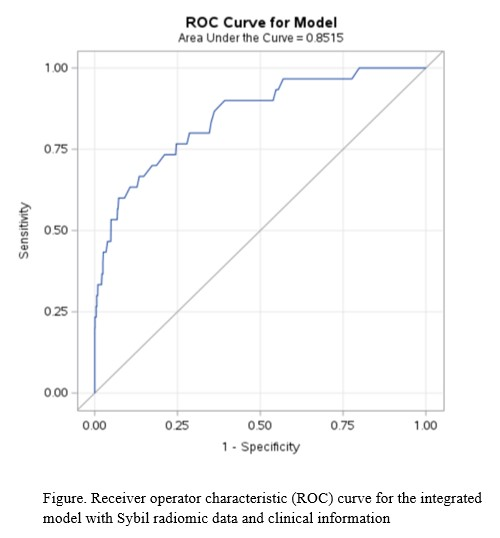
Results: A total of 1495 patients were included in the analysis. Median age at time of first scan and pack-year for the cohort were 64 and 40, respectively. By initial Lung-RADS, 782 (52.3%) were 1, 566 (37.8%) were 2, 81 (5.4%) were 3, and 64 (4.3%) were 4. In total, 30 patients were subsequently found to have LC (2.0%), of which 17 (56%) received an initial Lung-RADS score of 4. On univariate analysis, female sex, presence of emphysema and COPD, personal history of cancer, and higher Sybil scores were all significantly associated with LC (p < 0.05 for all). On multivariate regression, female sex (odds ratio [OR] 2.88; 95% confidence interval [CI] 1.24 – 6.67), emphysema (OR 7.82; 95% CI 2.87 – 21.3), personal history of cancer (OR 3.58; 95% CI 1.61 – 7.99), and the Sybil LC predicted risk score at 1 year (OR 1.015; 95% CI 1.01 – 1.02) were all associated with increased likelihood of LC diagnosis. Area under the curve (AUC) for the predictive model using Sybil as the single independent variable was 0.709. AUC improved to 0.852 with the addition of the significant clinical risk factors.
Conclusions: Integration of selected clinical risk factors for LC can refine the predictive ability of radiomic modeling and may lead to a more personalized risk prediction of LC development in those undergoing screening.
Benjamin Zollinger (1), Annie Son (2), Sriya Yalamanchili (3), Jared Miller (2), Rithvik Gabbireddy (3), Kimberly Pullen (3), Hongkun Wang (4), Melanie Subramanian (3), Simran Randhawa (3), Michael Weyant (3), Amit Mahajan (3), Kei Suzuki (3), (1) Inova Fairfax Hospital, Fairfax, VA, (2) University of Virginia School of Medicine, Charlottesville, VA, (3) Inova Schar Cancer Institute, Fairfax, VA, (4) Georgetown School of Medicine, Washington, DC
|

