马上注册,阅读更多内容,享用更多功能!
您需要 登录 才可以下载或查看,没有账号?立即注册 
×
Feasibility of Panitumumab-IRDye800 molecular imaging for intraoperative tumor localization of lung cancer
Panitumumab-IRDye800分子成像应用于肺癌术中肿瘤定位
Panitumumab是EGFR抗体。使用EGFR抗体会有什么优势呢?与叶酸受体
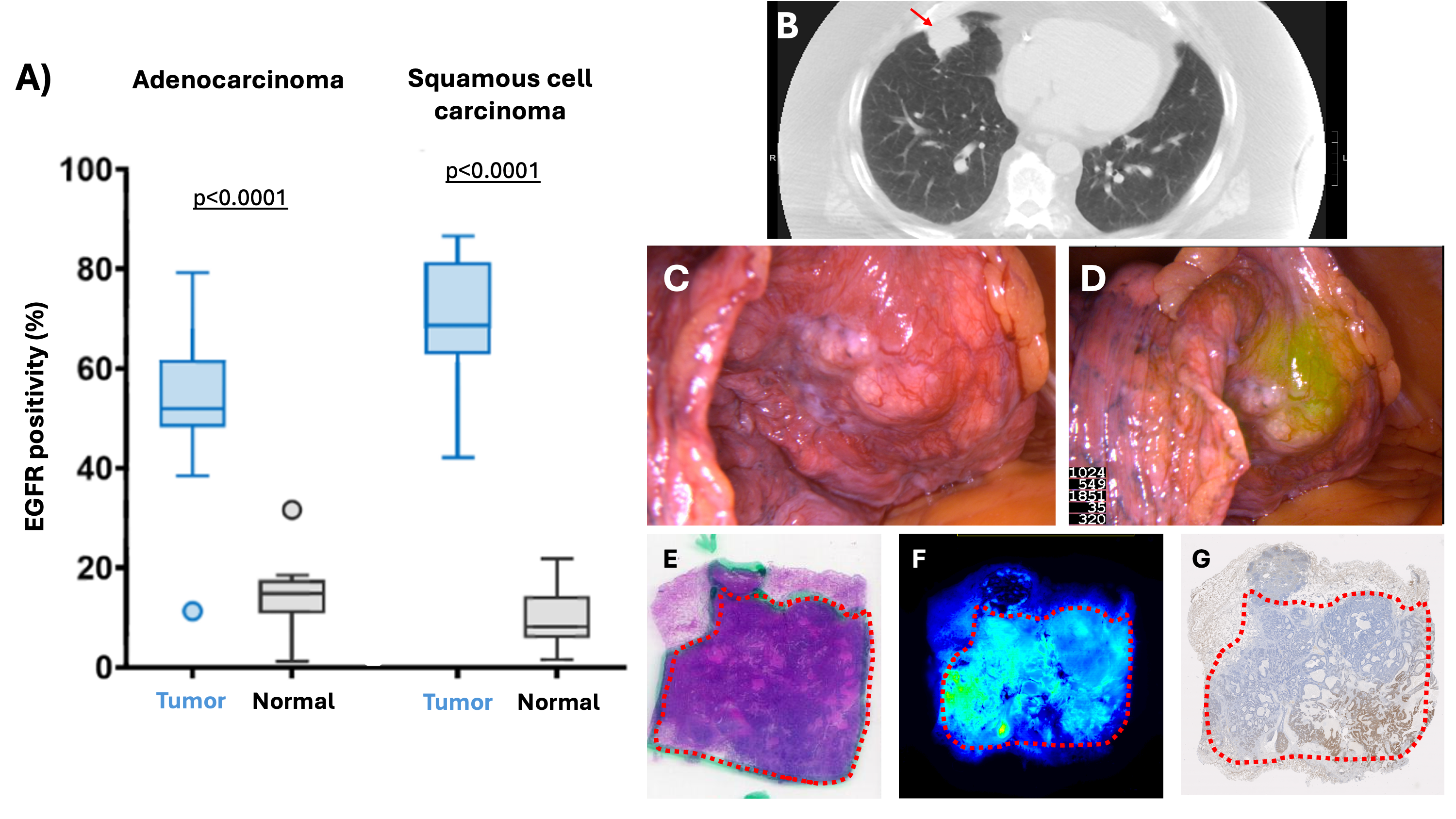
Objective: Panitumumab-IRDye800 (pan800) is a molecular imaging agent composed of panitumumab, an epidermal growth factor receptor (EGFR) antibody, conjugated to IRDye800, a near-infrared fluorescent dye. We aimed to evaluate EGFR expression in non-small cell lung cancer (NCSLC) and determine the feasibility of pan800 molecular imaging for intraoperative tumor localization. Methods: We conducted a preclinical study to assess EGFR expression in NSCLC compared to normal lung in surgical specimens. Subsequently, patients with NCSLC scheduled for surgical resection were enrolled in a single-center, phase 1, open-label, dose-escalation study (NCT03582124). Patients received pan800 infusion at a range of doses and days before surgery. Surgeons used white light, then pan800 molecular imaging, for tumor localization; surgical resection was then performed per standard of care. The primary objective was to determine the optimal dose and timing for intraoperative tumor localization, with secondary endpoints including quantification of ex vivo tumor fluorescence. Results: In our preclinical study, we found significantly higher EGFR expression in tumor versus normal lung in 12 adenocarcinoma (51.8% vs. 14.6%; p<0.0001) and 14 squamous cell carcinoma (69.5% vs. 9.6%; p<0.0001) specimens (Figure 1A). Subsequently, 11 patients with adenocarcinoma were enrolled and received a pan800 infusion (25, 50, or 75 mg) 1–5 days before surgery (Figure 1B-G). Four (36.4%) patients had successful intraoperative tumor localization using pan800 imaging; the median in vivo tumor-to-background ratio (TBR) was 2.70 [IQR 2.27–3.03], ex vivo TBR 3.34 [IQR 2.92–3.46], tumor size 2.3 cm [IQR 1.3–3.1], and tumor-to-pleura distance 0.1 cm [IQR 0.0–0.2]. Seven (63.6%) patients had no intraoperative fluorescence; median ex vivo TBR 2.21 [1.67-2.7], tumor size 2.2 cm [IQR 1.0–2.6] and tumor-to-pleura distance 1.9 cm [IQR 0.95–3.0], the latter significantly higher (p=0.01). The optimal dose was determined to be 50 or 75 mg, and timing of 2-4 days before surgery; 4/7 (57.1%) patients who received pan800 infusion in this range had successful intraoperative tumor localization. Conclusions: Our study demonstrates that NSCLC overexpresses EGFR suggesting pan800 is a promising imaging agent for intraoperative tumor localization. Preliminary findings from our clinical trial suggest an optimal dose of 50-75 mg and timing at 2-4 days before surgery, and enrollment is ongoing to refine these parameters
Carolyn C. Chang (1), Guolan Lu (1), Quan Zhou (1), Nynke S. van den Berg (1), Jake Kim (1), Irmina Elliott (1), Brandon Guenthart (1), Douglas Liou (1), Leah Backhus (1), Mark Berry (1), Joseph Shrager (1), Kavitha Ramchandran (1), Nathaniel Myall (1), Michael Ozawa (1), Eben Rosenthal (2), George Poulstides (1), Natalie Lui (1), (1) Stanford University Medical Center, Stanford, CA, (2) Vanderbilt University, Nashville, TN
|

