马上注册,阅读更多内容,享用更多功能!
您需要 登录 才可以下载或查看,没有账号?立即注册 
×
延迟手术对I期非小细胞肺癌生存的影响:美国退伍军人全国队列研究
结论:I期非小细胞肺癌,从诊断时开始手术延迟超过6周提高死亡风险和并可能提高复发风险。
Impact of Surgical Delay on Survival in Stage I Non-Small Cell Lung Cancer: A Nationwide VA Cohort Study
Objective: In early-stage Non-Small Cell Lung Cancer (NSCLC), emphasis has been placed on minimizing time to surgical resection. The objective of this study was to determine effects of delay in surgical intervention on oncologic outcomes.
Methods: A retrospective, nation-wide cohort study was conducted of Veterans who underwent surgical resection for Stage 1 NSCLC between January 1, 2016, and September 26, 2024. Patients were excluded if they underwent neoadjuvant chemotherapy or radiation therapy, or were diagnosed at time of surgery. Data collected from the VA Informatics and Computing Infrastructure (VINCI) was analyzed, compiling patient-specific data and survival.
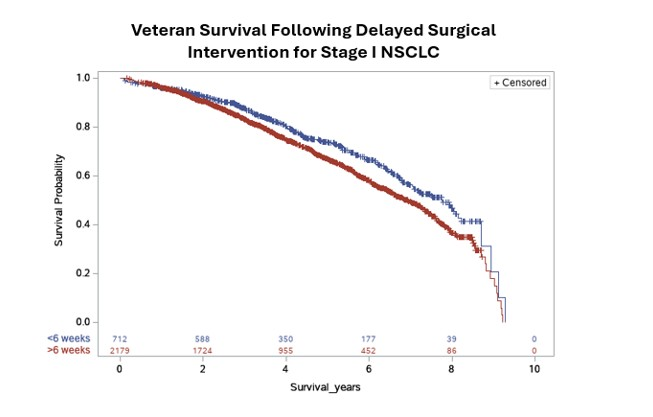
Results: A total of 2,891 veterans were included. The average age was 69.2 ± 6.5 years. The majority of veterans were male (2719, 94%), white (2258, 78.1%), current smokers (1436, 49.7%), American Society of Anesthesiologist (ASA) score of 3 (2470, 85.4%), and 51-100% service connected (1426, 49.3%). The most common histology was adenocarcinoma (1888, 65.3%). The most common surgical approach was thoracoscopic (1994, 69.0%) with lobectomy (1938, 67%) as the most common resection, along with 1-10 lymph nodes evaluated (1271, 44.0%) at time of resection. 1377 (47.6%) of veterans were treated at designated VA Cancer Centers. In the average follow up period of 3.8 ± 2.2 years, there were 308 total veterans with a recurrence (10.7%) with an average disease-free survival of 1.98 ± 1.5 years in those veterans. There were 979 total deaths (33.9%) with 944 deaths attributed to cancer-related causes. Average time to surgery from date of diagnosis was 11.7 ± 15.6 (range 0–336.1) weeks. After propensity score matching for 16 variables, cox proportional hazard regression modeling noted delay of surgical intervention of > 6 weeks from date of diagnosis was associated with a 25.7% increased risk of cancer related mortality (HR 1.257, CI 1.075-1.470, p <0.001), while demonstrating a trend toward significance in increased risk for recurrence (HR 1.151, CI 0.878 – 1.509, p <0.015). <10 lymph nodes examined at time of resection was associated with a 44% increased risk of recurrence (HR 1.440, CI 1.114-1.862, p <0.015).
Conclusions: Delay in surgical intervention in Stage 1 NSCLC greater than 6 weeks from time of diagnosis is associated with increased risk for mortality and may be associated with increased risk of recurrence.
Benjamin Scott (1), Edward Ward (2), Irina Veytsman (3), Jared Antevil (4), Gregory Trachiotis (5), (1) Army Medical Dept., Bethesda, MD, (2) Georgetown University Hospital, Washington, DC, (3) Washington DC Veterans Affairs, Washington, DC, (4) Washington, DC Veterans Affairs Medical Center, Bethesda, (5) Veterans Affairs, Arlington, VA
|

