马上注册,阅读更多内容,享用更多功能!
您需要 登录 才可以下载或查看,没有账号?立即注册 
×
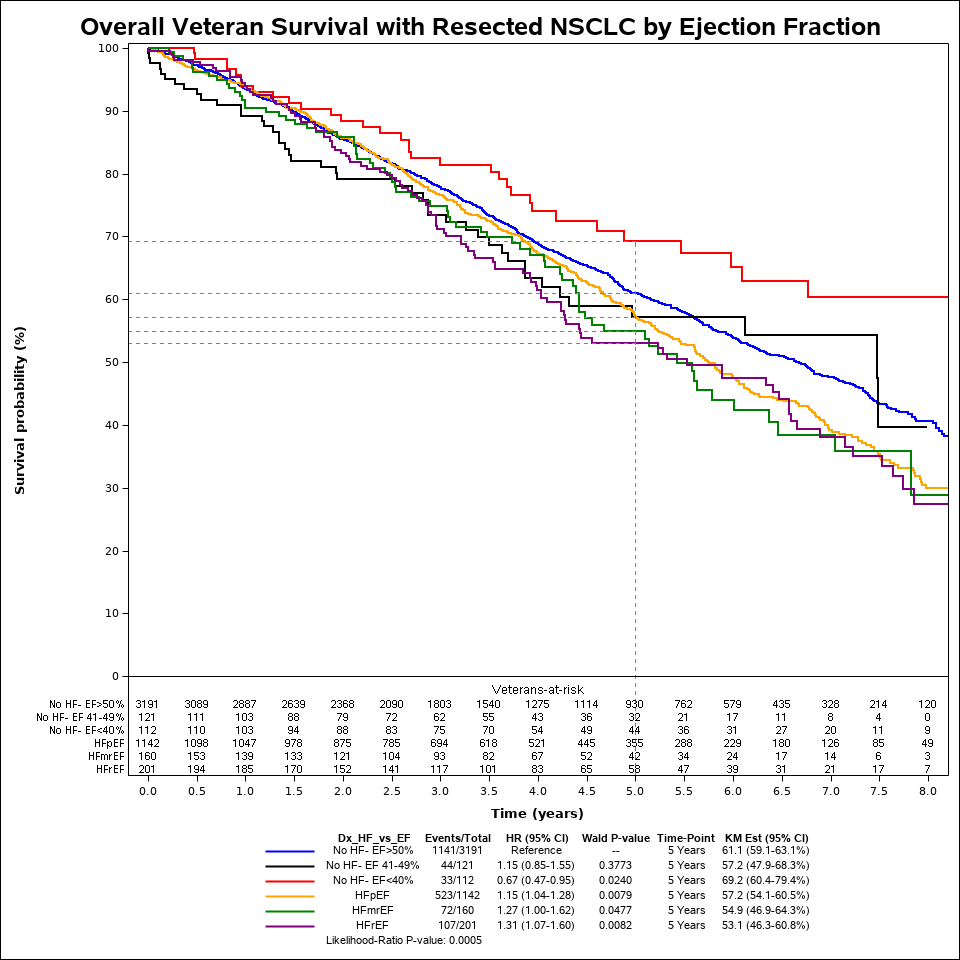
经过调整的人群分析,无论术前左心射血分数水平( left ventricular ejection fraction ,LVEF),非小细胞肺癌术后60天内心衰与无心衰人群的5年生存分别为56.3% (702/1503) 和 61.2% (1218/3424) ,差异显著 (p=0.0002) 。因为病例数多,虽然总人群在绝对数值上的差异并不大,但统计学上有差异。LVEF<50%者,应该考虑将心脏功能做为评价手术风险的因素。
Impact of Heart Failure and Ejection Fraction on 5-Year Survival after Non-Small Cell Lung Cancer Resection
Objective
The objective of this study is to evaluate the association between both clinical heart failure (HF) and left ventricular ejection fraction (LVEF) and 5-year survival in United States Veterans who underwent pulmonary resection for non-small cell lung cancer (NSCLC).
Methods
This is a retrospective cohort study of Veterans in the Veterans Affairs Surgical Quality Improvement Program who underwent pulmonary resection for NSCLC. The Veterans Affairs Informatics and Computing Infrastructure was used to assemble relevant demographics, oncologic and surgical details, and postoperative outcomes. Statistical analysis was performed in SAS Enterprise Guide. Inclusion criteria: (1) diagnosed with NSCLC between January 2016 and September 2024, (2) underwent pulmonary resection, and (3) had LVEF data from an ECHO performed within 6 months of surgery. Eligible veterans were divided into two cohorts based the existence of an ICD9 or ICD10 diagnosis of HF and then further stratified by their most recent LVEF into "EF>50%", "EF 41-49%" and "EF< 40%" consistent with the American Heart Association's HF guidelines. Cox Proportional Hazards Regression was used to compare outcomes. Covariates controlled for include stage, histologic subtype, age, gender, race, Hispanic ethnicity, BMI, and tobacco history. The primary outcome is 5-year survival post-resection with results stratified by preexisting HF diagnosis, pre-operative LVEF, and tumor stage.
Results
In total, 4,931 Veterans met inclusion criteria and were included in this analysis. Evaluation of risk adjusted outcomes demonstrates a significant 5-year survival difference (p=0.0002) in patients with and without a clinical diagnosis of HF measuring 56.3% (702/1503) vs 61.2% (1218/3424) respectively. When stratified by LVEF for all stage NSCLC, 5-year survival was significantly lower for patients diagnosed with HF than their non-diagnosed counterparts regardless of pre-operative LVEF.
Conclusions
This study shows that Veterans with a HF diagnosis had a lower overall survival at 5 years post-resection of NSCLC compared to their non-diagnosed counterparts. These findings persisted across all categories of LVEF for early-stage NSCLC and overall NSCLC when not stratified by stage. This association includes HF with preserved EF, further supporting the importance of the clinical diagnosis. These findings may be important when stratifying pre-operative risk for patients with NSCLC undergoing pulmonary resection.
Edward Ward (1), Robert Young (2), John Kucera (3), Benjamin Scott (4), Jared Antevil (5), Gregory Trachiotis (6), (1) Georgetown University Hospital, Washington, DC, (2) George Washington University Hospital, Washington, DC, (3) Walter Reed National Military Medical Center, Arlington, VA, (4) Army Medical Dept., Kensington, MD, (5) Veterans Affairs Medical Center, Washington, DC, (6) Veterans Affairs, Arlington, VA
|

