马上注册,阅读更多内容,享用更多功能!
您需要 登录 才可以下载或查看,没有账号?立即注册 
×
The Role of Lymphangiography and Thoracic Duct Embolization in the Management of Postoperative Chylothorax
术后乳糜胸:淋巴管造影和胸导管栓塞
Lymphangiography 淋巴管造影
Objective: Thoracic duct embolization (TDE) has been used for refractory chylothorax in patients unfit for surgical thoracic duct ligation (SDL). We hypothesized that TDE can be employed more broadly and avoid reoperation. We aimed to describe the efficacy of TDE for postoperative chylothorax.
Methods: We performed a single institution retrospective review of postoperative chylothorax from 2018-2024. Data included demographics, risk factors, chest tube outputs, and management. Descriptive, univariate, and receiver operator curve analyses were used.
Results: 73 patients were treated for postoperative chylothorax. The most common operations were pulmonary resection (n=27, 37%), and esophagectomy (n=24, 33%). 66 patients were initially treated with diet change (22 NPO, 2 low-fat) and 24/66 (36%) chyle leaks resolved. 40 patients had persistent chyle leak and underwent a procedure (35 TDE, 4 SDL, 1 sclerotherapy). Chest tube output was higher in patients who failed conservative management, both before (1106 mL vs 664 mL, p=0.003), and two days after (773 mL vs 282 mL, p=0.001) diet change. Chest tube volume >= 1130 mL before diet change (PPV of failure 91%) and >= 375 mL 48 hours after diet change (PPV of failure 97%) were highly predictive of failed conservative treatment. The choice of diet (NPO or low-fat), fluid triglycerides, neoadjuvant chemotherapy and/or radiation were not associated with failed conservative management. Notably, neither was index operation (p = 0.76). After failing conservative management, TDE was successful in resolving the chyle leak in 83% of cases (n=29/35). Fluoroscopic identification of duct leak (p=0.03) was associated with treatment success. TDE success did not vary by initial operation (p=0.69). There were 2 (2/47, 4.3%) major and no minor complications after TDE. NPO days (5 vs 2 days, p=0.27) and chest tube days (6 vs 4 days, p=0.51) were similar between TDE and SDL. Cisterna chyli cannulation (52% vs 83%, p=0.05), and technically successful intervention at lymphangiogram (65% vs 94%, p=0.05) improved over time (2018-2021 vs. 2022-2024).
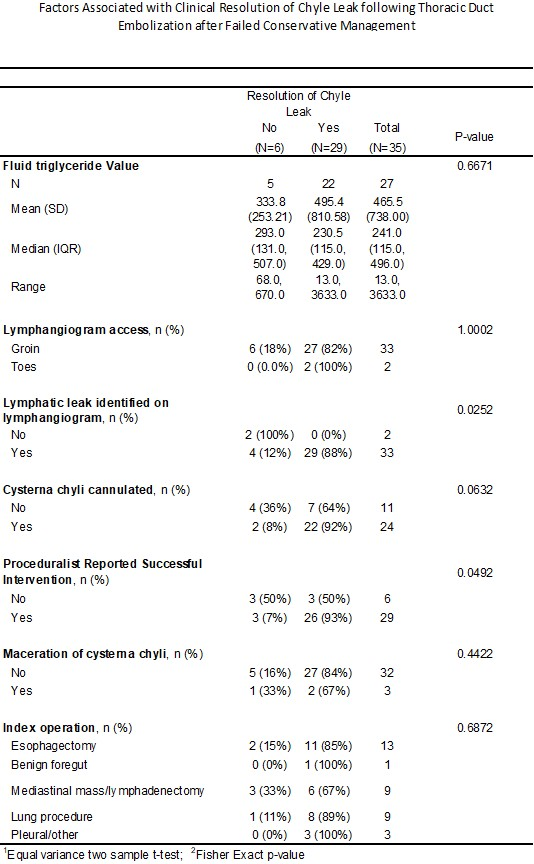
Conclusions: Dietary modification can resolve one third of postoperative chylothorax cases. Chest tube volume predicts failure and identifies patients who would benefit from early intervention. TDE is a safe and effective second line therapy regardless of the index operation. Albeit a challenging procedure, technical success rates of TDE can improve over time with increased experience.
Matthew Aizpuru (1), Rupesh Andani (1), Robert Vierkant (1), Brett Curran (1), Stephen Cassivi (1), Carlos Puig Gilbert (1), Sahar Saddoughi (1), Luis Tapias (1), K. Robert Shen (1), Dennis Wigle (1), Emily Bendel (1), Edwin Takahashi (1), Matthew Augustine (1), Michael Jundt (1), Scott Thompson (1), Chris Reisenauer (1), Janani Reisenauer (1), (1) Mayo Clinic, Rochester, MN
|

