马上注册,阅读更多内容,享用更多功能!
您需要 登录 才可以下载或查看,没有账号?立即注册 
×
Positron Emission Tomography/Computed Tomography Radiomic Subtypes in Clinical Stage IA Pure-Solid Non-Small Cell Lung Cancer
PET/CT Radiomic Subtypes in Clinical Stage IA Pure-Solid NSCLC
Objective: Clinical stage IA pure-solid non–small cell lung cancer (NSCLC) lacks reliable imaging prognosticators beyond tumor size and SUVmax. This study aimed to identify radiological NSCLC subtypes using radiomics from positron emission tomography/computed tomography (PET/CT).
Methods: Patients who underwent lung resection for clinical stage IA pure-solid NSCLC with preoperative PET/CT were included. Hand-crafted radiomic features were extracted from preoperative 18F-FDG PET/CT. To ensure robustness and reduce redundancy, we: (1) excluded features with an intraclass correlation coefficient < 0.80; (2) removed one feature from any pair with an absolute Spearman's correlation > 0.80; and (3) selected the survival-related feature by using univariate Cox regression. Consensus clustering was performed to identify radiomic subtypes of NSCLC. The radiology, pathology, and outcome differences between subtypes were subsequently compared.
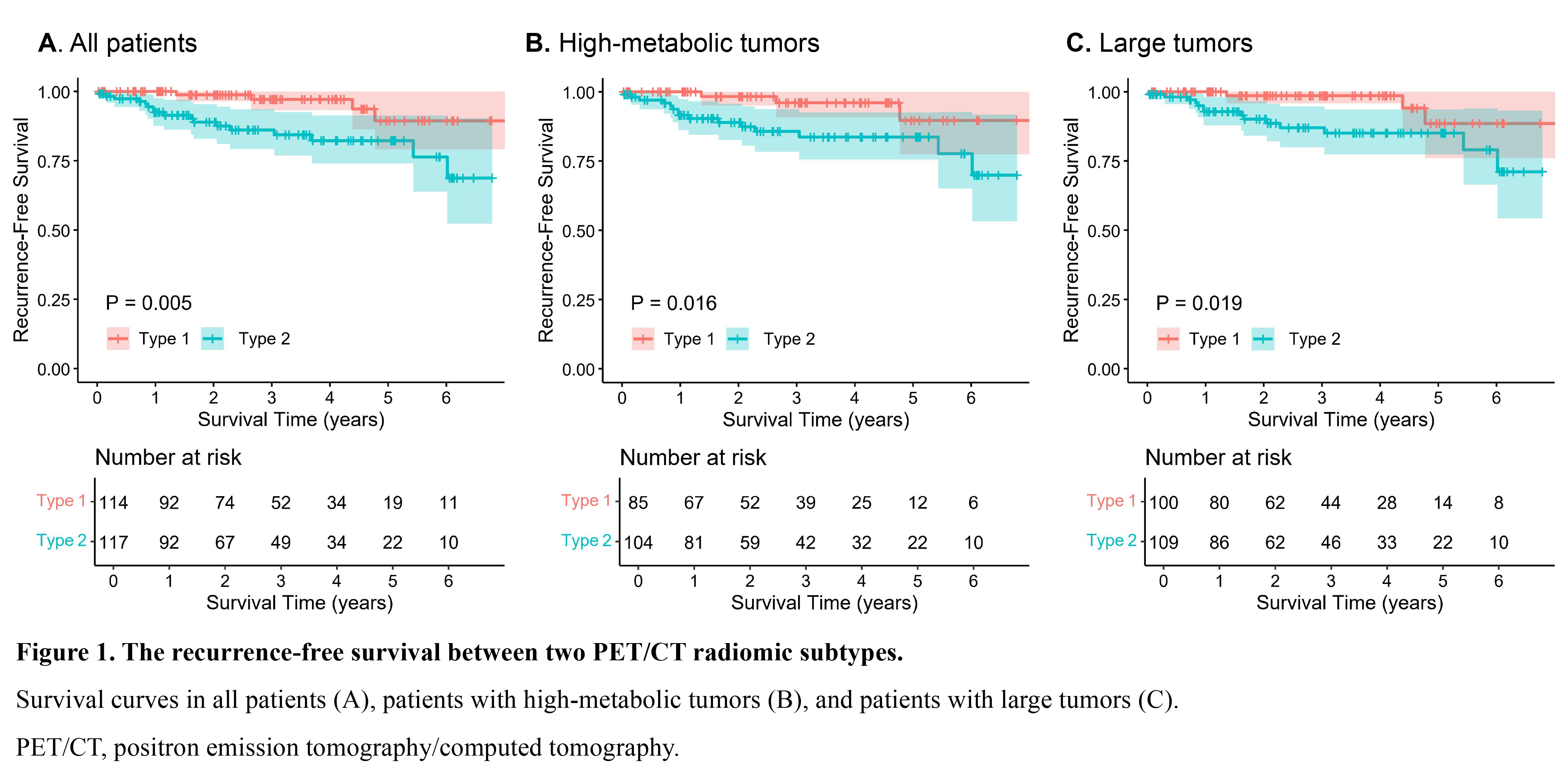
Results: A total of 231 patients with clinical stage IA pure-solid NSCLC were analyzed. Two PET/CT radiomic subtypes (type 1 and type 2) were identified. Compared with type 1, type 2 demonstrated more frequent cavitation (P < 0.001), more pleural attachment (P = 0.042), and higher SUVmax (mean: 8.4 vs. 5.0; P < 0.001) on imaging. Pathologically, type 2 showed more lymphovascular invasion (35.0% vs. 21.9%; P = 0.027), occult lymph-node metastasis (16.2% vs. 3.5%; P = 0.001), and more advanced pathological stage (P < 0.001). Type 2 was significantly associated with worse recurrence-free survival (RFS) (P = 0.005; Figure 1A). In the high-metabolic tumors (SUVmax ≥ 2.7) and large tumors (IA2 and IA3), type 2 still showed worse RFS than that in type 1 (P = 0.019 and 0.016; Figure 1B and 1C). The key radiomic feature was the Large Dependence Emphasis on PET, which can accurately discriminate type 2 from type 1, with an area under the curve of 0.887.
Conclusions: PET/CT radiomics identifies two clinical stage IA pure-solid NSCLC subtypes with distinct radiology, pathology, and survival outcome. These radiomic subtypes may provide additional preoperative risk stratification.
Haoji Yan (1), Ryusuke Sumiya (1), Yukio Watanabe (1), Takeshi Matsunaga (1), Mariko Fukui (1), Aritoshi Hattori (1), Kazuya Takamochi (1), Kenji Suzuki (1), (1) Juntendo University School of Medicine, Tokyo, Japan
|

