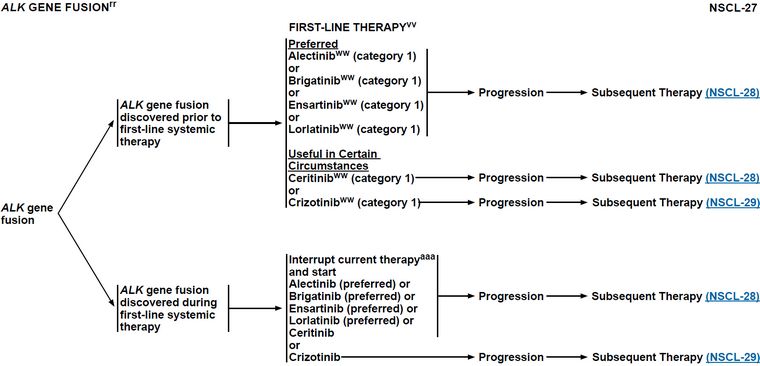
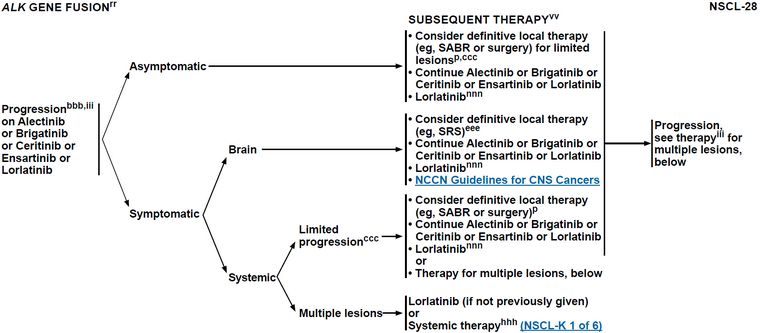
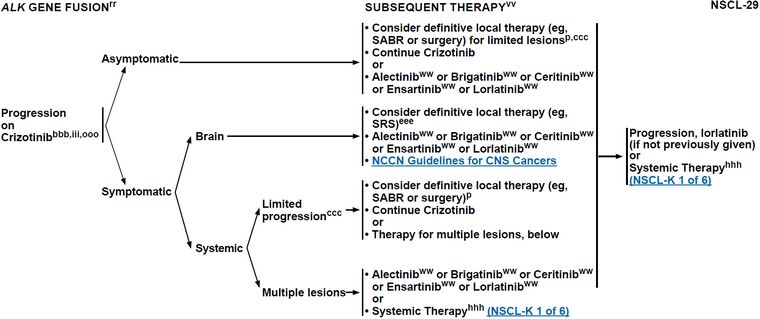
p IGTA therapy (eg, cryotherapy, microwave, radiofrequency) may be an option for select patients. 见 影像引导下热消融治疗原则(NSCL-D).
rr 生物标志物分析原则(NSCL-H).
vv 晚期或转移性疾病的生物标志物指导治疗原则(NSCL-J)
ww For PS 0–4.
aaa If there is a good response to current therapy, it is reasonable to continue therapy.
bbb Beware of flare phenomenon in subset of patients who discontinue TKI. If disease flare occurs, restart TKI.
ccc Clinical trials have included up to 3 to 5 progressing sites.
eee Definitive local therapy of CNS disease can include asymptomatic lesions at risk for symptomatic progression based on factors including site, location, and edema.
hhh The data in the second-line setting suggest that PD-1/PD-L1 inhibitor monotherapy is less effective, irrespective of PD-L1 expression, in EGFR exon 19 deletion or
L858R mutation, ALK+ NSCLC.
iii Plasma or tissue-based testing via MGPT should be considered at progression for genomic resistance mechanisms. If plasma-based testing is negative, tissue-based
testing with rebiopsy material is strongly recommended. Practitioners may want to consider scheduling the biopsy concurrently with plasma testing referral.
nnn Lorlatinib is an option for resistant mutations, such as ALK G1202R and L1196M (except compound L1196M/G1202R).
ooo Patients who are intolerant to crizotinib may be switched to ceritinib, alectinib, brigatinib, ensartinib, or lorlatinib. NCCN-NSCLC-2026V6 NCCN非小细胞肺癌指南导航